
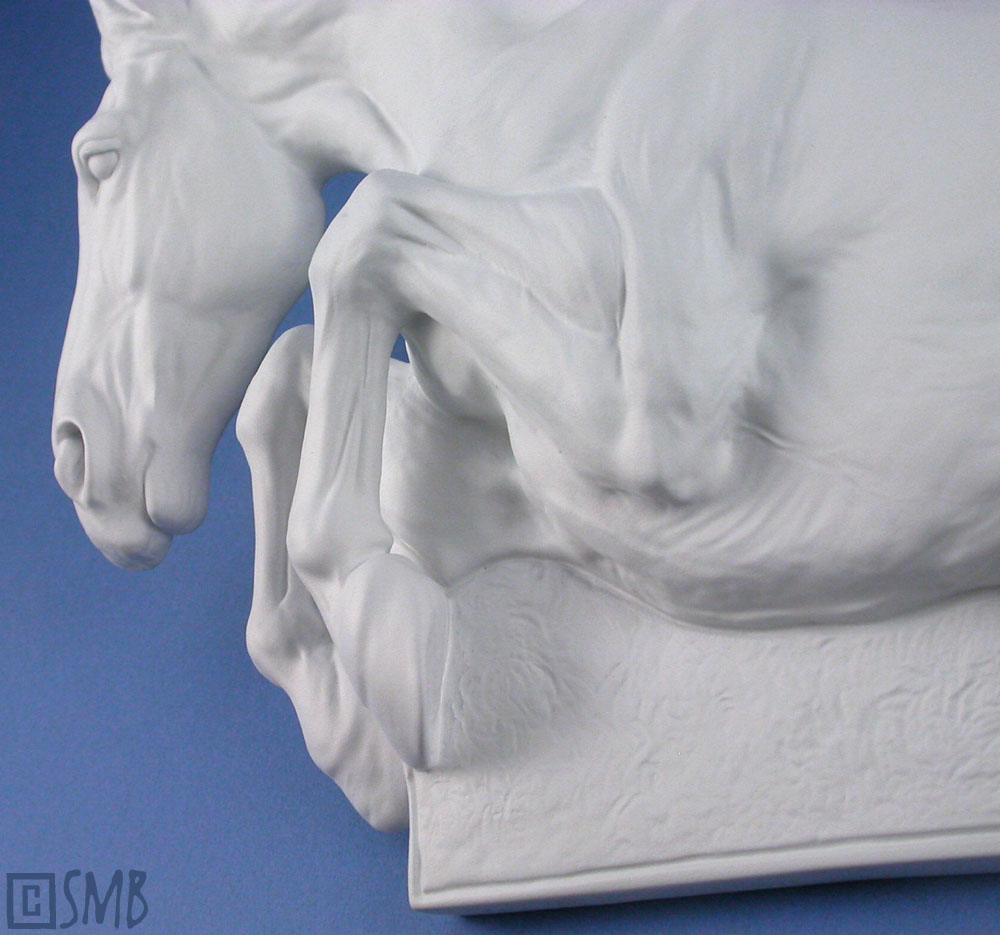
"Look Ma! I'm jumpin' outside the lines!"
(a snippet of a Jax plaque)
It's against my nature to do what I'm told. Something deep down makes me rebel against boundaries, being told what I can and can't do. I don't know...maybe it's because I prefer to do things my own way, or it could be that I want to win my own triumphs and make my own mistakes on my own terms. Doesn't mean I can't take orders if I'm inspired to follow, but most of the time I dance to my own drum. Then again it could be that, as my husband lovingly observes, I'm just a brat.
But being a brat isn't always compatible with art, especially when it comes to standardized formats. If you're familiar with my previous bas-relief work it's clear I don't like to sculpt "inside the lines." To me the boundaries of the edging shape are meant to be toyed with playfully, being a suggestion rather than the rule. This not only results in a better design, but it opens up design possibilities otherwise unattainable. So if a wisp of mane, twitch of an ear or a flick of a fetlock need to pop out more -- no problemo! Just do it.
But this idea cannot be applied to tile cutters. These things are designed in specific, industry-standard shapes and used to cut the clay slab into pre-sized portions for tile pressing, just like a giant, spring-loaded cookie cutter.

Here are some of my trusty tile cutters to give you an idea of what I mean by "cookie cutter." While they're worth their weight in gold in terms of handiness, they do force a limitation on design. The trick is to interpret the limitation as a positive -- because in the long-run, it is.
Now I could sidestep this issue altogether and slip-cast everything, but the problem is time. Tile pressing is faster and less labor intensive whereas slip-casting requires quite a bit of baby-sitting and delay during the casting process, plus the cleaning up of mold seams. If I want to keep my gift ware affordable and keep the process easy enough to maintain inventory (and evidently the ease of tile pressing is a challenge even with that this year), I'm forced to rip down the time required to finish a single item. The less time my hands are on it, the more affordable I can make it and the more of them I can make, but that cannot be achieved with slip-casting when I'm the only one doing all the steps.
I think this is the #1 mistake artists make when trying to make a living at art: they don't understand that their time is everything. It's all they have. Every moment of every day is an essential building block to success, and no amount of talent, drive, or business savvy can compensate for misused time. The moment an artist doesn't treat her time like a finite resource is the moment she's out of business. Making a living at art isn't only a passion -- it's a discipline.
What this also means is that thinking beyond the boundaries of a project is beneficial more often than not. Many years back, I took a workshop with Veryl Goodnight (with my buddy Lynn, a trusty workshop-mate), an artist I greatly admire. In her gentle shrewdness Veryl conveyed to us lessons perhaps more important than those imparted about sculpting, one of them being: maximize your time use. You spent time, skill and energy creating that one piece -- so is that where it stops? No! Rethink, reuse, reapply! Whatever other application that piece can be adapted to is in your best interest. It can get your work into more hands, it can open up new opportunities and partnerships, and it can ensure greater financial gain to allow you to continue to create art for a living.
All these years later I still remember this smart sense and have begun applying it to my gift ware and collectibles in earnest. By maximizing the possibilities for a single bas-relief or stamped tile design, I'm essentially maxing out every minute and iota of energy I put into creating it in the first place. I'm literally completing multiple pieces at once.
So...back to bas-relief and boundaries. The rub with tile cutters is their fixed shapes which don't allow for all those fun pointy-out bits outside the "parent shape." Rubbing salt into the wound, installations and all tile accoutrements are manufactured along those standard shapes so unless I want to spend a mint on commissioning custom-made tile accessories (with an accompanying lofty retail price), I'm stuck with the limited dimensions of the cutters. Like a stinging game of dodgeball, I have to stay inside the circle...or square, or rectangle. Oh snap!


Here's my Feral Mare medallion in cold-painted resin (top), my Reflective plaque in glazed slip-cast earthenware (middle), and one of my new CubequinesTM in original oil clay (bottom). These pieces demonstrate what I mean by "sculpting outside the lines" with design portions that pop out beyond the oval, circle or square, respectively.
This reality makes me chomp on the bit like a snarfly pony. Poofy-haired and pudgey and oh-so irritated. It's also immensely difficult design-wise. For me to create a design that plays nice within the lines can take almost twice as long as one that doesn't simply because I don't have the cheat of busting through the boundary.
This border war may not seem like a big deal, but when it comes to bas-relief or stamp design, it's pivotal. What makes this art form so intriguing is its unique blend of sculpture and flatwork. It's basically a 3D painting. As such, it's best approached as a painting (for bas-relief) or graphic design (for a stamp) rather than as a sculpture.
So actively employing concepts about composition, positive or negative space, narrative and line so fundamental to flatwork really help. Indeed, they can make or break a piece. No amount of technical finesse, popularity of subject matter, or novelty of an idea can make up for compositional errors, just like with flatwork. In short, a horse head on a flat background with lots of empty space isn't the way to approach it. Bas-relief isn't about the subject, it's about the design.
So actively employing concepts about composition, positive or negative space, narrative and line so fundamental to flatwork really help. Indeed, they can make or break a piece. No amount of technical finesse, popularity of subject matter, or novelty of an idea can make up for compositional errors, just like with flatwork. In short, a horse head on a flat background with lots of empty space isn't the way to approach it. Bas-relief isn't about the subject, it's about the design.
And when it comes to the design, the outer border, or shape, determines what you can and can't do with the piece in future applications; it dictates the versatility of the piece and mandates production methods. So if I want to invest my time most efficiently, which is imperative with this kind of work, I need to create a shape that has the most potential, able to be applied to all kinds of casting and projects. In other words: I have to do what I'm told -- I gotta sculpt within the lines. Argh! Leave it to clay to put me in my place.
The reason I bring this up now is because of two new Unicorn bas-relief tiles I'm working on, a matched pair with a moon and sun motif...
The reason I bring this up now is because of two new Unicorn bas-relief tiles I'm working on, a matched pair with a moon and sun motif...

Here's the first incarnation of the moon design (very roughed out), with all the sticky-outy parts so typical of my approach. I really liked this draft. A lot. Then Veryl's words rang in my head. I realized this design would force me away from tile pressing, the very thing that was my primary intention for this set. I had to bite the bullet and redo it to fit into the 4.5" circle dictated by my circle tile cutter.

Voila. Here's the retweaked design (still very roughed out). I wanted to make the Unicorn as large as possible while avoiding "kissed" borders or gobs of empty space. The way I got around that was to add another circle, in this case a border, to let me poke parts out while still remaining inside the parent circle. So I got to lob some teaser shells at the boundary while still playing nice. "Does this bug you? I'm not touching you!" And, ultimately, this is a stronger design and far more versatile. I figure the Unicorn has universal appeal, so it would be unwise to limit its potential simply because of design.
Over the course of the next few weeks, I'll document the completion of these two designs in oil clay as well as their pressed ceramic production, plus how I adapt them to different projects. Along with stoneware and earthenware, me thinks porcelain is a definite must. But they're also destined for resin casting and perhaps metal later on. Most of all, I've got my eye keenly fixed Glasclay. Can you imagine these in glass?! Swoon! And all thanks to embracing boundaries.
Now all this doesn't mean that I'll be creating bas-reliefs only in these standards shapes from now on. Only selected ones. I have a workaround for the odd balls, and one I'm quite excited about. But I'll leave that for a future blog post when I actually implement it. The beauty of this workaround though is that it allows me to adapt any shape to any standard tile accessory, but since it requires an investment of more time, resources and energy at the back end of production, it's ideal only for specialty items. Anyway...back to the work bench!
"And this is one of the major questions of our lives: how we keep boundaries, what permission we have to cross boundaries, and how we do so." ~ A.B. Yehoshua


