Showing posts with label projects. Show all posts

Tuesday, February 26, 2013

The Method, The Madness and The Mystery—Part 2


I suspect this is how "my team" feels when I start a new piece. My tools were too busy weeping to pose for this pic. My hands won't even talk to me.

Welcome again to The Method, The Madness and The Mystery, a sculpting series following the creation of a frolicking Dutch Draft Horse stallion, "Himmy." If this is your first time here, you may want to pop on over to Part 1 to get up to speed.

In this Part 2, we're going to discuss some initial philosophies when I sculpt a new piece. Now I'm sure you're thinking, "Can we just get onto the sculpting, please?," but I assure you that introducing these ideas now will help you understand some points and choices later. So…

The First Steps


When I start a new piece, I like to define some goals I'll use to decide when the piece is finished and successful. These goals are different with each sculpture and are part of the inspiration for their creation because, along with the fun and fulfillment, I consider each new sculpture a new learning opportunity, a new means to push my skills. I actually prefer to create "on the edge," of finding that boundary where I'm uncertain, nervous, and unfamiliar…and jump. Though I may be risk adverse in life, when it comes to art, I have no sense of self–preservation. So if I'm not thinking to myself as I sculpt, "What the heck am I doing?! This is going to be a disaster! I'm never going to be able to pull this off! What was I thinking?!," then I'm not pushing enough.


For better or worse, I also don't trust comfort zones and find that, at least for me, complacency tends to breed a false confidence that dampens "my team's" ability to really rise to the occasion. Instead then, I like "everyone" to be on wide–eyed Red Alert, and that only happens when I've thrown myself into a metaphorical howling abyss—screaming. Who needs sky diving when there's art? Just as in life then, horses are also teachers in the studio, and so Himmy will teach me to:

  • Nail the proportions and build of a really heavy draft horse.
  • Imbue a lively personality without appearing wild or unruly.
  • Recreate a winter adult coat fluttering in the gallop.
  • Achieve a sense of weightlessness despite his hulk.
  • Produce a sense of nimble speed despite the base.
  • Recreate a sense of billowing, splattering kicked snow.
All that means I'll keep working on Himmy until I've achieved these goals to my liking. But some of them won't be easy. In fact, I consider Himmy to be the most difficult concept I've tackled so far because of them. That may seem surprising, since Himmy appears to be relatively straightforward, but those goals actually entail elements more systemic than musculature, type, or texture. What's nagging my sense of confidence then? Life.


Here's the thing…realistic art aims to duplicate life as accurately as possible to fool the eye—but art is entirely different from life. Said another way, inanimate clay and a living animal are two totally different things. Really think about that. Let it soak in for a moment. Though that statement may sound absurdly obvious, it's surprising just how many artists don't fully anticipate the implications for realistic sculpture. What—how? Because it implies that sculpting what we see isn't how one sculpts realistically. Now I've been working on a sculpting series that deals with that specific issue in much greater detail, but in the interim we'll approach it from this angle…

Unconsciousness vs. Consciousness

In life, our brain 
automatically processes three functions of an equation commonly regarded as "reality." Being automatic, they're instantly recognized and processed by our unconscious mind both in field study and our studio and as such, tend not to be readily identified by our conscious mind.  

First are the natural physical forces, The Universals, such as kinetic energy, force (including centrifugal and centripetal force), gravity, mass, inertia, cause and effect, drag, friction, resistance, impulsion, thrust, contraction, rebound, center of gravity or mass, leverage, tension, equilibrium, acceleration, fluid dynamics, and a host of other effects. Using Himmy as an example, we instantly know that if he were alive, he'd be a massive hulk (being a draft horse), he'd be moving fast (since he's galloping), he'd be benign (since he's happy and excited) and that what he's running through is puffy and crunchy (we know the texture and qualities of snow). Our brain does this on autopilot as a function of the fight or flight response because it wants to make sure that Himmy won't trample us before it decides to admire him. We usually don't even notice this initial deduction has been made—it being so automatic—that is, if Himmy isn't running at us! Then we get out of the way before we look again.

Second is biological reality, what we think of as "anatomy." In its simplistic form, this allows us to identify a horse as a "horse" and different from a cow, hippo, or platypus. By the time we're old enough to sculpt realistically, we usually recognize a horse from a donkey, from a mule, between the breeds and perhaps even the genders. In targeted training for equine realism, we can then recognize sculptures with more accurate equine structure from others; we can recognize progressive degrees of equine feasibility in sculpture. We are then better able to factually and objectively answer the question, "If that sculpture of a horse was alive, would it be a viable horse?" These are The Givens, those aspects of structure that define the basis of equine realism—anatomy and biomechanics*. No piece of realistic equine sculpture can be "realistic" if it doesn't come as close as possible to technical accuracy, by definition, since looking like a horse and factually depicting a horse are indeed two very different things. For more discussion on equine realism in sculpture, you can download my article, "Walking the Tightrope; The Unreality of Realism," I wrote for The Boat here.


(*For the purposes of this series, biomechanics will now be considered interchangeable with anatomy, since the former is simply an inevitable expression of the latter.)


Third, once our brain has been educated—which is safe to say with horse enthusiasts—it automatically pinpoints The Variables, those factors that create further distinguishing aspects such as breed standards, conformation, grooming, tack, and preferred movement. With more training, the better we become at ascertaining these nuances. Having said that, however, no amount of prowess in The Variables can compensate for errors in The Givens when it comes to equine realism, which is precisely why they're Variables.

Our brain processes all of these three factors unconsciously so that our conscious mind can take them for granted and thus be freed to focus on those aspects that appeal to us—and there are lots of 'em with such a captivating critter! These features are The Irrationals, those aspects of our equation that are spontaneous and may be specific to cause and effect, such as individual features, expression, gesture, personality, presence, posture, motion, hair movement, etc. Indeed, The Irrationals are usually those very particulars that often inspire a new piece in terms of concept, design and composition. And like 
The Variables, no amount of prowess with The Irrationals can compensate for errors in The Givens. 

The fifth factor to all this is us! Our goals, our skills, our discipline, our workmanship, our knowledge base, and all those elements our brain draws upon to drive us in this art form—but we'll leave that for another blog series. Now there is a sixth factor, which is…

Is Reality Really What We See? 

The sixth factor, the one staring me in the face, are precisely all those components not registered by my conscious mind, The Invisibles. I don't have the luxury of automatic processing with clay. It's just an inert lump. Instead then, I have to recreate a self-contained, complete universe from scratch, so I have to readily recognize everything. Simply put, my brain cannot take anything for granted so that yours can. I refer to this hidden ingredient as "Living Moment" and it factors back in all those elements processed under our radar and so tend to go unseen.


See, here's the other thing about realism: despite all the elements we have to consider as we work, we still cannot factor out our own brains. And this is exactly the reason why simply sculpting what we see isn't how one sculpts realistically. Can you guess why by now? Yes! It's because your brain actually functions as a Reality Filter. What's more, your own unique circumstances of nature and nurture culminate into an individualized, custom–made Reality Filter all your own. And the same applies to each of us. This is why different sculptures have different degrees of accuracy, and it's also why each of us pick up on different things when looking at the same horse or sculpture. It's why different artistic styles exist, too. So because each of our Filters has a unique set of priorities, goals, blind spots, habits, aesthetics, proclivities, and preconceptions, we each have our own unique view of reality. Ultimately then, all of our different Reality Filters are what account for every differing factor in realistic equine sculpture.

That's where my problem lies, and on two fronts: not only do I have to tackle my own Reality Filter, I have to tackle yours as well. This means I must constantly revisit the question, "What really constitutes reality?" In doing so, I'm obliged to address those very things unprocessed by my consciousness only because I can't rely on my Reality Filter to show me what reality actually is. This is why I prefer a Red Alert situation. Hey, no one on my team can get comfy when everything we're engaging is suspect—including my own mind!


And it's here where Living Moment comes to our rescue. It's truly enlightening when you take a new look at something and strip away all your preconceived notions about how it should look. Only when you do that—only when you can do that—do you start to see reality as it really is rather than how you want it to be. Indeed, what reality is and what we think it is are two very different things, thanks to our Filter.

So because Living Moment involves effects usually imperceptible to our conscious selves, we need to learn how to recognize, interpret and translate them to infuse them into our clay. Yet our brain cannot do this on its own—it has to be shown how and then guided to maintain that state of awareness throughout the sculpting process. But this is neither easy nor intuitive because we're asking our brain to bring what's registered on the "automated" unconscious level up into our "manual" conscious level for objective analysis. Plus, our unique Reality Filters means those particulars are usually different for each of us. So in a way, Living Moment is to an artist's brain what Self–Carriage is to a horse. And like each horse is an individual—one who will need different training methods to address his unique personality quirks—so each of our brains will need its own customized training to help it perceive and translate Living Moment.

We'll explore some ideas on that to get you started, but once our brain gets the knack of it, it really keys in on the constellation of fleeting events unfolding every second as we begin to recognize how the different substances, structures, textures, components, features, emotions, and reactions in life are thus affected. Through this, innumerable little touches that input actuality into our sculpture are revealed, exponentially increasing our creative choices and taking our work beyond representation and into narrative, beyond formula and into serendipity. Only then do we start to See the full spectrum of reality and realize that we cannot separate a believable subject from a believable universe, that we cannot sculpt realism in a contextual vacuum. Realism isn't about sculpting a factual horse then, it's about sculpting a factual reality that happens to feature a horse.
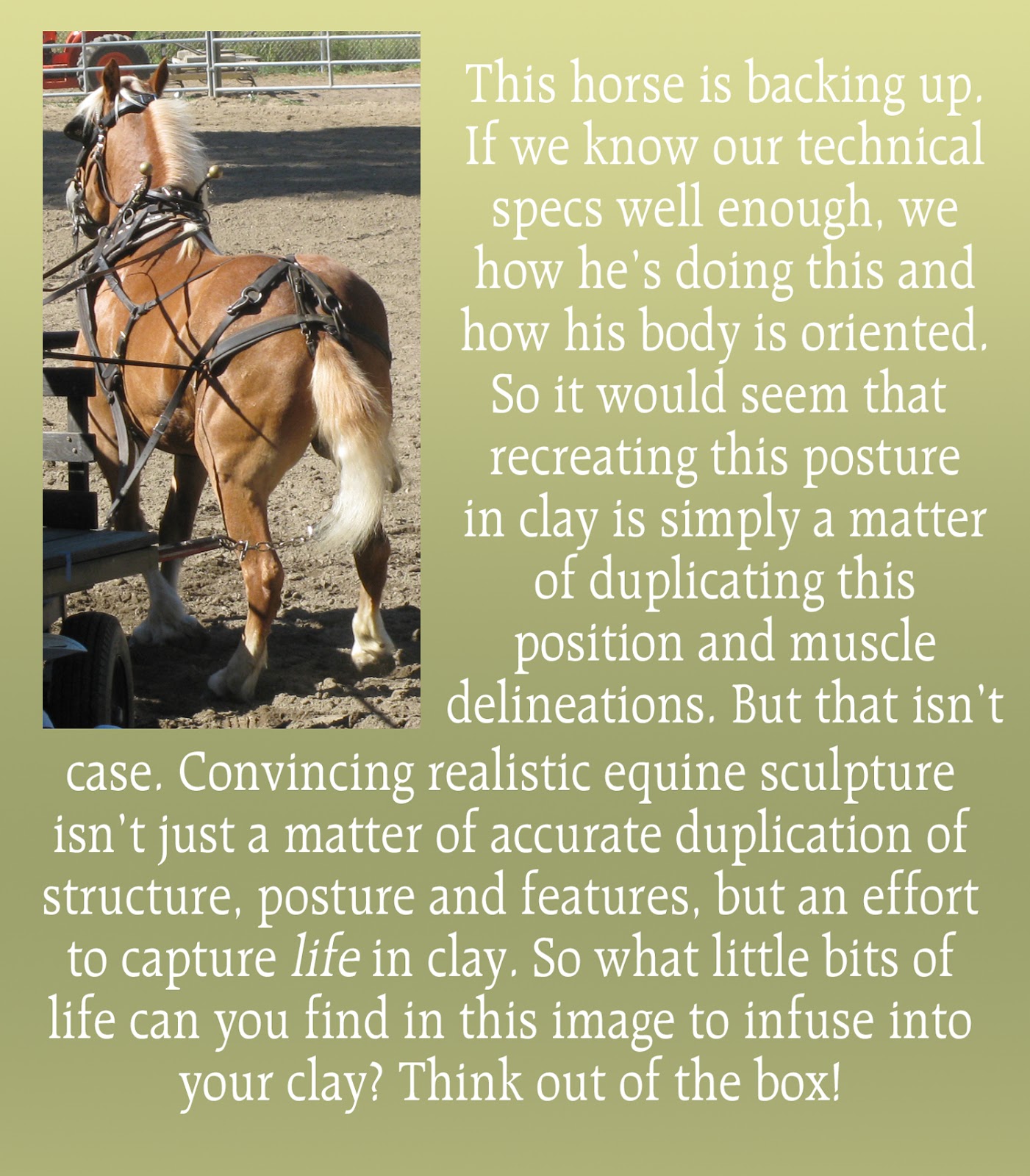


So What Exactly Does All This Mean?

Boiled down, Living Moment addresses just that—sculpting a factual reality, a complete universe. Because of this, it incorporates the physical forces and biological consequences our brain would otherwise take for granted—and thus tend to omit from clay—that impart a sense of immediacy, a sense of "realness," a degree of "changeability" beyond The Universals, The Givens, The Variables and The Irrationals. Altogether, the concept recognizes that no one moment is alike as each unfolding one is entirely new. This suggests that we cannot sculpt any two sculptures alike, right down to our anatomical interpretations. Heck, it suggests we cannot even sculpt each side of our subject the same! In all, we're quietly reminded that not only is each animal a unique individual, but each moment is unique, too. For some ideas on what that means for sculpture, refer to my two–part anatomy interpretation series here and here.

Practically speaking then, one way to think of Living Moment is that our sculpture is like a movie still—a single frame within a continuum—with these storyline components:
  • The Universals create a believable setting.
  • The Givens create a believable visual.
  • The Variables create believable value judgements.
  • The Irrationals create a believable individual.
  • Living Moment knits all this together into a believable plot.
  • Our mind is the interface.
In other words, Living Moment refers to the physics and biology applicable to our equine figure within the context of the scene portrayed. That means I won't be sculpting a draft horse galloping in the snow. That's only thinking of part of the equation. Instead, I'll be sculpting a universe in which a draft horse happens to be galloping in the snow. That's the full equation. Perhaps you can see now that there's a big difference between depicted movement and depicted Moment.


The Essential Dilemma

When we grasp this idea, we then start to see the implications for our sculptures. For instance, Living Moment indicates that aptitude in The Givens isn't enough. Sure, clinical expertise can take us pretty far in realistic equine sculpture, and it definitely takes quite a bit of effort to achieve in any measure. The equine is arguably one of the most difficult subjects to sculpt realistically, having stymied countless artists throughout the ages. Even Degas admitted great difficulty with the subject! So there's good reason why technical precision is such a struggle in the beginning of our careers, and why we work so hard to continually refine it.


Yet no amount of clinical accuracy can help us express the quintessence of a living creature or the transitory essence of life, as mountains of technical illustrations, anatomy charts, and representational pieces prove. So if we want our efforts to go beyond this, we're asked to go beyond positioning a 3D anatomy chart in different poses with different breed outlines. Flipping this over then, another implication is that the more we strive to sculpt with absolute clinical precision, the less realistically we tend to sculpt. Accurate anatomy may be at the basis of realistic equine sculpture, but if that's all we focus on, we're going to miss the most important component itself—life.


We'll explore all of this throughout this series, too, but it all comes down to this: just as horses "fill in" for us (as Tom Dorrance so wisely taught us), our brain fills in for art as well, and for realism in particular. Here's the deal summed up by this blunt quote: 
Realism has to be such high quality, you can't fake it. It's all hanging out there like the laundry. ~ Nelson Shanks
This art form is a kind of magic trick in that I'm trying to convince you that the illusion I've created is real enough to suspend disbelief for just a moment. Realism cannot be faked, fudged, or phony, which is why the more gripping works appear "more realistic" because they are more realistic. By definition, realism isn't something we can just make up—it's dependent on rules, The Givens. The more rules we perceive and employ then, the more convincing our work becomes.

But therein lies a trap, the belief that the more adept we become in duplicating the rules, the more correct and convincing our sculptures automatically become. And this is true
—but only to a point, remember. Because we all know that Nature is as much about rules as it is about breaking them, and that idea applies to our sculptures as well. That is to say we must come to know the rules so well, and so far beyond a chart or illustration, that we also discover how and when to break them, too. And it's Living Moment that guides us.

We are sculpting living animals in mercurial moments, not anatomy charts or registry diagrams. So our work must be equal parts precision and organic if our brain is going to be truly tricked because this is what our brain already registers in life. Really, does your brain see a skinned horse galloping around a paddock in life, like an animated anatomy chart? No. It sees a living, organic horse. Put another way, your brain already factors in that organic nature unconsciously—it simply takes it for granted because it takes the fact the horse is living for granted. Indeed, your brain automatically strips away features of the Living Moment to simplify the visual.


But when we look at a realistic equine sculpture, our brain unconsciously looks for that organic nature—that mental function is spinning in a loop looking for that stimuli in the sculpture that it finds in life. And in a piece that follows The Givens too literally, that circuit is tripped almost as effectively as if The Givens had errors. When our brain cannot find that organic, Living Moment element in a sculpture then, it will attempt to "fill in" for that missing ingredient—and the moment it's forced to do so, the piece registers as "not real," and POOF—the spell is broken.

So
—yes—the quickest way to break this spell are errors in The Givens, but the more subtle way is an inadequate infusion of Living Moment. And in certain pieces especially, Living Moment can play a far more critical role in that spell's power than just about anything else…and Himmy is exactly that kind of piece. 

The Challenges

So in case you haven't guessed by now, five key Living Moment elements that will take center stage with Himmy are:

  • Weight vs. weightlessness (Himmy vs. his gait)
  • Impulsion vs. rooted (his gait vs. the base)
  • Resistance vs. velocity (his coat vs. the wind generated by his gallop)
  • Mass vs. fluffy (Himmy vs. the snow)
  • Flesh vs. velocity, impulsion, resistance and suspension (Himmy's fleshy bits vs. the act of galloping in snow)
And that's just the tip of the Himmyberg! If I'm successful then, Himmy will appear as if he's moving very fast and nimbly, as though he's floating during that suspension phase of the gallop, but also come across as the massive, powerful hulk of a horse he is. If I'm really successful, you'll also "feel" the crisp air ruffle his winter coat, you'll "hear" the snow crunch and pop as his dinner plate hooves smoosh and fling it, you'll "sense" the rumble of his hooves as all that bulk thunders by, you'll "see" the fluffy snow splatter, billow and spray under the kick of his heels, you'll "listen" for his snorting breath and blows, and you'll "connect" to his happy, joyful attitude. He'll have context; his moment will be complete. Altogether then, if I account for Living Moment well enough, your moment be transported to his moment and—for just a second—you'll share something with each other that mimics the same feeling you would have if he were real and you were there with him. 

That's the magic trick. And I sure hope I can pull this bunny out of the hat!


NEXT TIME: Part 3: Materials and Tools


"What is magic? In the deepest sense, magic is an experience. It's the experience of finding oneself alive within a world that is itself alive. It is the experience of contact and communication between oneself and something that is profoundly different from oneself; a swallow, a frog, a spider weaving its web…"  ~ David Abram

Share/Bookmark

Monday, August 6, 2012

1 + 1 = 1 in Art


Pixie, painted by Danielle Feldman, 2012.

One of the coolest things about creating sculptures for "blank" resin castings is seeing how other artists interpret them. Regardless of media or chosen color scheme, each painter has a different Voice, and if we're paying attention, that creative fingerprint is as unique as the painter.

One of these gifted artists—Danielle Feldman—has put together a wonderful montage on her blog of those pieces of mine that she's painted over the years. What a treat! Thank you Danielle for your hard work and dedication! You help my sculptures sing! 

"I like the idea of collaboration—it pushes you. It's a richer experience." ~Frank Gehry

Share/Bookmark

Saturday, November 12, 2011

The Creative Stewpot


It's funny how some things are just meant to be, and in their own time. Life's a mystery, a wonderful thing to be sure. Indeed, a couple of weeks ago I discovered just such a mystery languishing right under my nose for...oh...about seven years.

Back story. Okey dokey - I had a 1:9 scale Morgan family in the works some time ago. I started with the mare, but from Day 1 she was a battle. Nothing worked. And I mean nothing. It was one big sculptural Bataan Death March. So I stopped. I've learned it's just better to stop and switch gears rather than force things. Either I'm not ready yet, the planets aren't aligned, or the conflict originates in my inability to listen at the time.

On top of that, I later decided they needed to be in ceramic as well, and so they needed scaling down because at the time ceramic production was infeasible with pieces larger than 1:12 scale (albeit not anymore). Really, the mare's torso alone was a good 9" long, not to mention the neck, head or tail! Back then - before large pieces were slip cast in pieces - that meant the wet, loaded mold would have weighed enough to snap one's spine in half like fresh celery.  

So I made new scaled-down armatures and shelved the original versions in the dark recesses of my studio closet.

 Here's the second generation scaled-down Morgan mare armature. Her torso is only about 6" across. I enjoy creating family sets because I can play with one theme in different ways while also infusing interaction between the pieces.

However, stewing long before all this was the compulsion to sculpt a Lipizzan stallion. I keenly remember the Royal Lipizzan Stallion show Mom took me to eons ago when I was a wee tot, I think when I was in elementary school. Let's just say it made quite an impression.

However, what stopped me in the ensuing decades were the lingering doubts about my ability to truly capture the cavorting white steeds romping around in my imagination. For one, Lippies have a very distinctive look and presence while also imbued with the feel of a living relic, a horse from another age. The breed has a high degree of type variation, too, but despite this, it's surprisingly easy to sculpt them as too-Andalusiany, -Furiosoy, -Morgany, -Arabiany, -Kladrubery, or -Cobby and I risk missing the mark entirely. There's a delicate balance of key features needed to create a piece that immediately and unequivocally reads "Lipizzan." Complicating matters, these horses also incorporate nuanced ideas about anatomy, biomechanics and horsemanship due to their "old world" build and schooling.

Altogether then, one could say that the Lipizzan extravaganza Mom took me to all those years ago was a primary impetus for the development of my art career. Why? Welp, in the truest sense, portraying this breed incorporates everything one needs to know about realistic equine sculpting. But that meant the Lippies who paraded before my tiny, awe-filled eyes had to wait patiently in my head for 30-odd years before I'd come to understand how to do them justice. Some projects really just need to bubble and burble in a creative pot for a very long time. 

Here she is, just as I recently pulled her out of the closet. A GapoxioTM wad of frustration and self-doubt.

As these things tend to do spontaneously, all this smashed together in one of those Big Bang moments of seeming destiny. I was digging through my closet on a totally different hunt (of course) when I came across that old, dust-covered mare. In an instant epiphany, I saw her reborn as a Lippie stallion. It was a literal flash. Quite a powerful moment, actually. Then like my life flashing before my eyes, I realized that's what was fighting me all those years ago! I was forcing this piece to be something it didn't want to be - something it wasn't supposed to be! And too soon.

Here he is, cut apart to be re-pieced back together. Unlike many of my colleagues, I create my full-body sculptures from a self-hardening epoxy clay rather than soft oil clay, or waxes. This means changes can be a real PITA, but it does provide a permanent archival sculpture. This epoxy also has superior characteristics for capturing detail and fleshy effects with ease, at least for me.

So here he is, pinned back together and quickly rough-sketched in Photoshop to distill the idea. Still debating the head and left foreleg position - perhaps the tail, too - but I'll let him guide me this time 'round. While I'd like to eventually sculpt Lippies in the haute ecole and "airs above the ground" movements, right now the "cavorters" have to get out of my head after all these years.

(Above segment) The original version, and (lower segment) the new version. He's going to entail quite a bit of work with tweaking, correcting, re-proportioning and getting things in synch. For example, I see already that his gaskins and hind cannons are too long. However, I work from the withers "outward" so I'll make all the necessary corrections as I go, essentially "cascading" the errors out of his nose n' toes.

Representing a culmination of my entire art career then, this piece will be a true test of how well I've mastered the art form. A heckuva challenge, but I cannot wait to get started! I figure I can work on him alongside my sproinging Arab mare to usher in 2012 with a bang. 

But oy...he's gonna be big. My largest original to date! Heck, he's already the size of my HR Metalchex! This makes him a sharp departure from the smaller scales I've been creating lately, but it's fun to spice things up every so often. And while I don't know how his size will translate into resin or ceramic, I do think bronze is a definite must.

I'm so grateful that Mom encouraged my passion for horses at such an early age - look at the journey it started! A blessed path. What a wonderful thing to look back upon and reflect, and then be able to infuse into this grandiose and thrilling piece! The past and the future, stewing together within the joyous moment! Thanks Mom!

"It has happened more than once that a composition has come to me, ready-made as it were, between the demands of other work." ~ Amy Beach

Share/Bookmark

Monday, November 7, 2011

Variations on a Theme


If you follow this blog, you've probably picked up on a theme by now: my infatuation with serendipity. That is to say a fondness for variety, diversity, change, moment, uniqueness. The things that make each of us individuals and each second a complete universe. 

Creatively speaking, this translates into a gaggle of things to create paired with various ways to create them. Said another way, I not only have affection for variety in media, method and composition, but also for the various expressions of the equine form. Not talking about breed, gender or age differences here. Those are obvious enough. I'm talking about the more subtle differences in how anatomy manifests between individuals that make them individuals and how anatomy changes between moments that make them individual, too. Pour in expression and soul, and that's the fun stuff for me. The rules are just a means to the end.

Now granted, the rules are important. We strive hard to learn equine anatomy (to include biomechanics) as beginners and continue to refine our understanding throughout our career. Deeper than that, however, is the individuality of anatomy. No two individuals are alike and no two moments are alike. So applying the same habitual anatomical interpretation to another sculpture isn't the best plan if we seek to convey this animal's experience with authenticity. (I hinted at this effect a bit more in Parts I and II of my anatomical chart discussion if you're interested in more discussion on the subject.)

Also, when I see a horse, I don't see "a horse," or even a [insert breed]. I also don't make value judgments of "good" or "inferior," "beautiful" or "ugly." What I see instead is a unique individual, much like how I'd identify friends and family. Having evolved away from objectification in my art and towards exploration, I'm far more interested in those qualities that go deeper. How does the saying go? "We like people for their qualities, but we love them for their flaws." Well, I believe the same applies to equines.

Because of this, sculpting "perfect" specimens isn't very interesting to me. I mean, you're not lovely and worthwhile because you don't look like a movie star, centerfold or model? Nah. I don't find your value in how beautiful you are on the outside. And it's so subjective! Indeed, it's those things that make you different that allow me identify you as you! Isn't that much more fun? 

In a similar way then, repeatedly sculpting the same anatomical formula doesn't light my fire either. Sure, it's comfortable and safe, like all habits are, but the serendipity found in living anatomy entices me far more. The irony is that I've been telling folks all this time that I don't sculpt portraiture, but only now do I realize that's exactly what I've been doing. Only I just create portraiture of my own making.

Anyway, this direction came into sharp focus these past two weeks in the ceramic studio. As I mentioned in the previous post, I got a wild hair - as I'm prone to do (perhaps too often) - and cast some Reflective plaques in porcelain slip. I actually bought the jar of this magical stuff some years ago and it sat lonely on the shelf until I was confident enough to swim in its silky goodness. The Joy ornament from last year eroded any trepidation I had, so I figured it was time to swan dive.

Anyhoo, the mold cast easily and the two initial castings were a dream to clean. Greenware porcelain is interesting. You don't really clean it like you would earthenware, terracotta, or stoneware. You really just touch it with water and it "self heals." (In this case, a soft artificial paintbrush dipped in water.) It melts into exactly what you want. It also carves beautifully and holds detail like nobody's business. Imagine mixing talcum powder with butter - that's how it feels.

Elsie supervised the entire endeavor, taking period drinks from my water cup. Yes, I love tapioca pudding, so I have lots of those cups.

Which got me to thinking. Reflective in porcelain was exciting enough - yeah, great. But why stop there? Claybody them! Never mind that I've never worked with porcelain slip before. And let's just ignore the fact that I've never claybodied the stuff either. Don't even mention that I've also done zero research on the process and had absolutely no idea what I would be doing. Perfect! Let's go! Hey, the only way to learn is to stare looming failure in the face and cackle madly. 1.21 GIGAWATTS?!!

But there was a monkey wrench. Unbeknownst to me at the time, porcelain slip dries fast. Really fast. Way before I expected it - even in a cool, damp garage - these two castings were too dry to claybody. Once clay is past a certain drying point, the likelihood of added changes taking well plummet dramatically. In this case, they'd probably just pop off in the fire or create cracks*. So I opted instead to carve them rather than add alterations; to subtract rather than add. Thankfully, it was far easier than expected and terrific fun to boot!

[*In hindsight, little did I know about porcelain's vitrifying properties and how they can be manipulated, but they may have lent themselves to claybodying even these too-dry pieces. But I'll leave that for the next post.] 

So here are the results from the subtractive claybodying, pieces #1 and #2. With them, I simply carved away what I wanted to change rather than adding anything. On the top one, I detailed out those braids and on the bottom one, I made them smaller and more "cigarette-like," as well as removing them from the tail in dressage fashion. On both, I changed the facial features, especially in the muzzle area.

So having had such a great time with those two, I decided to go one step further: Cast three more for additive claybodying. To do that, I popped each fresh casting into a gallon-sized ZiplocTM baggie with a damp wadded paper towel in the corner, carefully squeezing out most of the air before zipping it closed. This keeps the casting wet, something necessary for additive changes.

Here's #3 - in the middle of the claybodying process - in the "wet bag" to keep it damp. You can put your in-process piece back in the bag to come back to it later. It can "keep" in there for a couple of days, but not indefinitely. A spray bottle filled with water and set to a fine mist is also a useful companion to keep the piece evenly damp during the process.

For additive claybodying, I need "slab" and "paste" porcelain rather than runny slip. To do that quickly, I simply pour some slip onto a plaster mold and let it dry enough to still be damp and flexible, but no longer runny. I can keep it as a slab for manes, tails, or bridging expanses, or I can turn it into paste by smooshing it in my palm with some water, as follows...

I make fresh paste each time - it just works better that way.

You can keep slabs fresh in the wet bag, too, or you can prepare them for paste in the "mushpool," or damp cup. Anything left over after you're done gets put back into the dump bucket to be used again for future castings.

Here's #4 in the works. To add on pieces, like manes and tails, both surfaces need to be well "scored" with a sharp tool, then both surfaces are slathered in slip (the same slip used for pouring the piece in the first place). Only then can they be stuck together, squishing firmly to really marry them together and to remove any air pockets (which would cause the piece to explode in spectacular fashion during the fire).
 
 Oh nose! You can also cut apart the piece and reglue it back together in the same fashion. Here you can see #5 getting a reset nostril after scoring and slipping. I cut it away and reset it lower, so I could carve the skull downward for a more Iberian build.

 Using both these techniques, here you can see #4 with his roughed-out mane and tail glued on, along with his reset ear and resculpted jowl and nasal bone. All other changes were done by subtractive sculpting.

 Likewise, here's #5 during the "ugly stage," using these techniques.

 And here's #3 during the ugly stage. You have to keep your eyes on the prize at this point because it's so easy to get intimidated!
 
As if all this wasn't enough - guess what. I got another wild hair. Yeah, I told you. I get them a lot. I've been intrigued by the various ways other sculptors rendered the eyes on their sculptures, actually carving in pupils and even the "eye dots" (or omlats), to denote light reflection rather than just a blank orb. I've always wanted to try it and figured - why not now?  
 
Here you can see what I mean by "sculpting eyes" rather than blank orbs. Initially it took creative acclimatizing - it's definitely a very different way of interpreting de peepers. But I really like how they turned out! "Sculpting with light" this way was a thrill, and I'll definitely consider it again where appropriate. And truth be told, I also wanted to discourage the painting of these pieces down the line by others, to instead be appreciated purely as a sculpture.

 Here's the fired result on #3 - fun, huh?

The beautiful thing about slipcasting porcelain is that it allows me to present my work as pure sculpture. I've always been more of a sculptor than a painter, so this is both pivotal and inevitable for me, having developed towards it over the years. I've lost the compulsion to "color" my sculptures, realistically or otherwise, and even clear glaze interferes with light reflection on a bisque piece, especially with finer details. Yet earthenware is too porous and stoneware a snidge too grainy for some of the projects I intend to tackle. For this goal then, bisque porcelain is perfect - it's vitrious and captures light brilliantly. It's also universally accepted in the "hierarchy of media," making it ideal for submitting work into art shows, and one I can produce in my own garage no less.

So as a bit of foreshadowing, this project (and those like it) has an agenda: to train me for one-of-a-kind pieces in porcelain, in bas-relief, bust and full body. I've long wanted to see if I could do this, and these baby steps are a good beginning. Lots to learn, lots of mistakes and lots of surprises, but what would art be without adventure? 

Similarly, this minimization of "coloring" is how I intend to approach my bronzes and OOAK hand-built ceramic pieces, too. So extreme, in fact, that I'm also toying with the idea of sculpting in pinto and appaloosa patterns, and perhaps even markings. The eye treatment I gave to these claybodies opens up the door to that. 

So here's the whole group in greenware. In the top left is the original version, right outta the mold. Again, forget about the different manes and tails, ears and breed types - those are just superficial differences. Instead study the different fleshy bits, such as around the muzzle and eyes. No two horses manifest flesh in the same way, so no two sculptures should manifest flesh in the same way either. I'm looking forward to tinkering with the eye and ear anatomy more in the next batch.

Here are some muzzle and cheek close-ups of #2, #3, #4 and #5 to clarify the point (after firing). The musculature and features in these areas are different on each piece because they're different on each individual in life. Can't wait to expand on this theme to cram my mental library with even more tidbits!

Anatomy may be the rules, yes, but nature bends them with each of us. If it didn't, every horse would look exactly the same, as each of us would, too. So because every equine is a fresh take on a theme, it's a joy to apply a fresh eye to each sculpture as well.


 During the point of vitrification, porcelain becomes gooey and flexible, and so thin, suspended bits tend to sag. To prevent this, I could either stilt the area (something a bit beyond my skill level just yet - but stay tuned!), or a substance called "porcelain prop" is commonly used. It's a cotton-ball like substance made from inflammable glass-like materials which can be shaped to support those prone-to-sag-bits without becoming fused to the piece (in this case that sticky-outy ear). It's also reusable. Just be super careful with it, as it does have asbestos-like qualities. I also learned to use only the tiniest point of contact with the piece, and put it just below the contact point in order to "catch" the area at the point of sagging. Heat builds up between the two surfaces, which can cause a regional point of over-fire. Lesson learned!

 Cone 6: 2232˚! Big Al's hottest yet! He seemed quite pleased with himself. I could hear him bruxing. I think I even caught him boggling those peephole plugs, too. Happy kiln, happy heart.

So here they are after the mature fire of Cone 6:


#1

#2

  #3

 #4

 #5

To see them in their creamy porcelain goodness is such a treat! It's also interesting to see how the clay softened and where during the fire, and where it kept its crispness. Mental notes for next time. The shrink rate was impressive - I wish I took a measurement photo of them in greenware so I'd have something to compare them to after firing. Next time!

Anyway, #2-#4 will be available for sale today in my Etsy store. #1 and #5 will be available a bit later - I have a couple of hiccups to fix first. Yes - you can fix low-fire porcelain after the fire! I learned this by serendipitous accident (literally) and I'll walk you through it in the next blog post. 

The many incarnations of Reflective: (left) bare white resin (middle) earthenware [in process] and (right) claybody custom bisque porcelain. Can't wait to apply this to future pieces!

Nonetheless, claybodying isn't just for fun. When approached from this deeper angle, it's an extremely useful artistic exercise that stretches the Eye. Applying different anatomical interpretations to the same piece encourages us to search for the mercurial and serendipitous in life. We're compelled to pitch formula and adopt variability. This not only turns the depiction of this animal into a far more fascinating endeavor, but it adds individuality and "living moment" to our work, letting it spring to life in ways no other approach can.

So you can bet that more claybody customs (often shorted by the acronym "CBCM") on my bas-relief works will be forthcoming, and I'm so jazzed now to create more expressly for this purpose! The Fates were shining down on me the day Joanie introduced me to clay - Joanie, you rule! Go raibh maith agat a milliún! ("Thanks a million" in Irish.)

"In ordinary life we hardly realize that we receive a great deal more than we give, and that it is only with gratitude that life becomes rich." ~ Dietrich Bonhoeffer

Share/Bookmark
Related Posts with Thumbnails