Introduction
Hello and we're back to this 17-part series exploring equine anatomy and biomechanics from an Intermediate perspective. We've already had a starter introduction, so now it's time to dig deeper. There's always more to learn with equine anatomy—it's a living subject. Literally!
In previous parts, we've discussed the head, neck, and topics ranging from terminology to evolution So in this Part X, we'll be discussing the equine torso. It's the biggest portion of the animal and full of its own special properties that make it a dynamic, integral aspect of equine art. Actually, in a very real sense, the torso is the most important element for depicting motion! Let's learn why...
Basic Structure of the Torso
The torso is like the support bridge and transmission of the horse, all in one. It's also what supports the saddle and cradles the rider. The spine consists of the neck (previously discussed) and the thorax, lumbar, sacrum, and tail vertebrae. The pelvis can also be thought of as part of the spine (but it'll get its own treatment in this series for the same reason the neck did). In terms of conformational references, the torso itself entails the loins, croup, dock, withers, chest, barrel (the ribs), sternum, groin, and tail.
The equine body is wider and flatter at the rear and narrower at the front. In essence, the equine torso isn't shaped like a tube or like a 2x4, but like a canoe with a narrow "keel" at the front and a wide, sprung shape towards the flank with a flat underside towards the groin. However, different breeds can have a different spring of rib, and therefore slightly different barrel shapes. The Arabian, for example, has a rounder, well-strung barrel, the Saddlebred has more of a heart-shaped barrel, and the Friesian can have more of a tube-like barrel. Moreover, the hindquarter, from point of hip to point of hip, is usually wider than the forequarter, from point of shoulder to point of shoulder. There are exceptions, however, such as chunky draft or pony breeds which can have a more equal width between the two at times.
The torso has bones (such as the ribs and sternum) in the front half, but a series of thick layers of aponeurosis fascia as supportive structures towards the rear (thoracic tunic); there are no ribs emanating from the lumbar vertebrae. The spinal column itself is slightly arched upwards to support the heavy viscera (despite what many erroneous diagrams and mounts depict, having straight columns), and has a downhill slant towards the front. It's the spinous processes of the thoracic vertebrae that form the familiar concave curve of the back between the peak of the withers and the point of croup.
However, different breeds or types of horses require a different tilt to the spinal column in order to go about their function properly or have proper type. For example, riding breeds such as the Arabian, Saddlebred, Morgan, sport horses, etc. should have an uphill tilt to their torso. In other words, the base of the neck should be level or higher than the LS-joint. In contrast, in speed, cow horse, and many draft breeds such as the Thoroughbred, Quarter Horse or Shire should have downhill balance in which the base of the neck is below the LS-joint. However, many drafters should alternately be of level balance, too, depending on the breed or type. Breeds that are of general use should have level balance such as the Akhal-Teke or Morab.
Skeletal Structure
The horse has approximately eighteen thoracic vertebrae (back), each bearing a pair of ribs. The spinal process of the fifth thoracic vertebrae generally is the longest, forming the peak of the withers. The fourth thoracic vertebra typically forms the visual junction between the neck and the torso. All the thoracic vertebrae articulate with each other and with their ribs, but within the limitations of their structures and connections.


There are approximately five to six lumbar vertebrae (loins) whose straight transverse processes establish the width of the loins. These transverse processes are long, wide, close together, and tightly bound to each other by ligamentary attachments. All the lumbar vertebrae articulate with each other, but within the limitations of their structures and connections.


The sacrum (croup) consists of five to six fused vertebrae, making a single inflexible bone triangular in shape (when seen from above). There are no joints in the sacrum, it being a solid block of fused bone. The limbo-sacral joint (LS-joint), between the last lumbar vertebra and the sacrum, is the point where the hindend is tucked and curled in bascule, cantering, galloping, pivoting, stopping, spinning, jumping, etc.
And bringing up the rear, the horse has generally eighteen coccygeal vertebrae (tail) that decrease in size to a pointed tip. The tail is the most flexible part of the spine even if the first coccygeal vertebra becomes fused to the sacrum in maturity. But because evolution caused the "semis" to pirate part of the coccygeal vertebrae, the actual, flexible part of the tail doesn't start until the third coccygeal vertebra.
The sternum consists of seven “sternebrea” that never completely ossify, though always stationary. It has a keel (the keel of the canoe-shaped barrel), and is deepest between the forelegs ("depth of girth") and most shallow and flat at the eighth rib, where it ends. It's an anchor for the pectoral muscles of the chest, as well as others.
The horse has eighteen ribs which descend at a slightly backward slant. From the first to the sixth rib, they're flatter and wider to become more arched and narrow towards the hindquarter. Only the first eight ribs attach directly, with cartilage, to the sternum and so are termed “true ribs." In contrast, the remaining ten ribs are called “false ribs" because they "float" with no connection to the sternum despite the thick cartilaginous "rod" that connects them together at the bottom, and to the last true rib. The ribs help to form, with the abdominal muscles and thoracic tunic, the external shape of the barrel.
Basic Musculature of the Torso
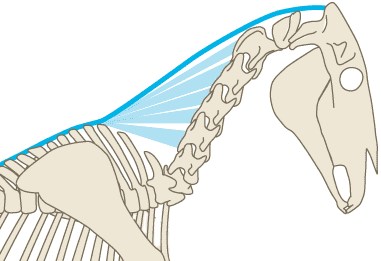
Though there are many ligaments that lash the vertebrae together, the major one in the torso is the dorsal ligament, which blends with the nuchal ligament of the neck.

In turn, the basic muscles of the torso are:
Though there are many ligaments that lash the vertebrae together, the major one in the torso is the dorsal ligament, which blends with the nuchal ligament of the neck.

In turn, the basic muscles of the torso are:
- Trapezius (thoracic portion): Moves the neck and scapula, or helps create a shrugging motion.
- Rhomboideus (thoracic portion): Flexes the shoulder.
- Latissimus dorsi: Helps to pull the humerus up and back, flexing the shoulder.
- Longissimus dorsi: Helps to flex the back and neck laterally, round the back, and lift the base of the neck in bascule. It is the single largest muscle in the horse. On a well conditioned horse, the groove of the spine lies between the two parallel masses of this muscle (when seen from the top).
- Longissimus costarum: Aids the longissimus dorsi.
- Semispinalis dorsi: Aids the longissimus dorsi. Often regarded as part of the longissimus dorsi. It continues as the semispinalis colli, up the neck to the axis bone.
- Multifidus dorsi: Aids the longissimus dorsi.
- Serratus dorsalis anterior: Fleshes out the back and can cause hollowing of the back when contracted.
- Serratus dorsalis posterior: Fleshes out the back and can cause hollowing of the back when contracted.
- Serratus ventralis (thoracic part): Supports and rotates the shoulder backward and also helps to articulate the ribs in breathing. Works with or antagonistically with its cervical counterpart (See Neck-Basic Musculature of the Neck in Part IX). Part of the shoulder sling.
- Intercostal muscles: These fill the spaces between the ribs and costal cartilages and have an external and internal layer. These muscles help with breathing.
- Internal abdominal oblique (or rectus abdominis): Aids in breathing, provides support for the contents of the torso and helps to bascule the back, flex the lumbo-sacral joint and aids in lateral bends of the back. Horses that work at the gallop have strong abdominal muscles and a subsequent tucked up belly, or "lady-waist."
- External abdominal oblique (or great external oblique): Aids in breathing, flexion of the lumbo-sacral joint and support for the contents of the torso. It joins its mate in a tendinous connection called the “white line” or linea alba down the underside of the belly.
- Transversus abdominis: Aids the external abdominal oblique.
- Abdominal tunic (or aponeurosis of the obliquus abdominis externus): Acts to support the contents of the belly.
- Anterior superficial pectoral: Helps to pull the forelimb to the median.
- Posterior superficial pectoral: Helps to adduct the forelimb and tenses the fascia of the forearm.
- Anterior deep pectoral: Helps to adduct the forelimb.
- Posterior deep pectoral: Helps to pull the forelimb backward.
- Biceps brachii: Helps to flex the elbow.
- Coccygeal muscles: Move the tail.
- Panniculus Carnosus: Serving as a skin muscle, it's the “fly shaker” and the most superficial muscle in the horse. Located mostly on the neck and trunk, it also lays over the pelvis and around the forearm and gaskin. On the forearm, it creates the basis of the elbow flap, and on the trunk, creates the basis of the stifle flap.
Biomechanics of the Torso
With all the leg motion, we might come to think that the horse moves on his legs to create forward motion. And he does. But the fact is all motion begins in the spine and not the legs. His legs are simply initiated and moved by the oscillations of the spine. The neck should also be included in "the spine" even with biomechanics, but it got its own post because of how involved it is.
Its structure and ligamentary network make the equine spine relatively stiff and unyielding to lateral motion. The conventional concept of "straightness" is misleading, when, in fact, the issue is far more fascinating and complex than simply "the fore quarter in front of the hindquarter." The most potential for lateral bend is before the sixteenth thoracic vertebra (specifically most of it is between T9 and T16), but lateral bend is most pronounced and facilitated by bascule. A hollow back cannot laterally bend very well which is why horses that move thusly lack suppleness and agility. Most transversal rotation occurs T9 and T14, about where the rider's thighs are. Overall, the horse's spine is more flexible than a camel's back, but less flexible than a dog's or cat's spine. Also, in order to bend, the horse pushes his ribcage outside of the turn, to "ride the rim" so to speak. He may also hold his tailbone in line with the curve.

The horse's relatively rigid back evolved to best facilitate structural stability for the body of a large herbivore who escapes danger at sustained speed. It speaks directly to the animal's evolutionary lifestyle. Indeed, a fast canter is the horse's most energy efficient stride! That said, however, the thoracic vertebrae can create an undulating up and down oscillation of about 2.25 inches (5.7cm) to hollow or round. These oscillations can also be induced by the rising or lowering of the neck. For example, hollowing occurs in a halter stretch starting in the spine, not the legs. Rounding occurs during bascule. The spine is also capable of a some rotational motion to allow the forehand to pivot more or less independently of the hindquarter, often exhibited on cutting horses. Most of this rotation occurs in the thoracic vertebrae since the lumbar are relatively more inhibited in this due to its tightly lashed lateral processes.

All the ribs articulate with their vertebrae and adjacent ribs in both an up and down and rotational front and back motion simultaneously. This makes the torso expand and contract in synch with breathing. However, one side of the ribcage cannot move independently of the other side; they work together.
The lumbar vertebrae, because of their tight ligamentary network between their lateral processes, are resistant to lateral flexion, though capable to a marginal degree. They're also capable of the same up and down motion of the thoracic portion, but it's designed specifically to "coil," or tuck the hindquarter under the body to launch the horse forwards efficiently.


The sacrum functions rather like a lever by articulating with the seventh lumbar vertebra at the lumbo-sacral joint (LS-joint). This flexion tucks the hindquarter under the body, and arches the spine upward to "round the back" and lift the base of the neck during engagement and bascule. It cannot laterally bend or rotate. Similarly, the LS-joint cannot laterally bend or rotate but can only operate as a "yes" motion up and down motion to alternately coil and uncoil the hindquarter under the body.

Depending on the specific situation the barrel will also swing like a pendulum over the supporting hind leg, referred to as "schwung" in German. However, it does so unless it's being pushed left or right in response to a turn or pivot, more or less. The ribs will move in an up and down rotational motion, too, when breathing as the rib articulates with its own thoracic vertebra and those adjacent.
Despite its relative rigidity, the equine back is flexible enough to accommodate a wide range of movement. All motion of the spine is amplified by bascule and reduced by a hollowback.

With all the leg motion, we might come to think that the horse moves on his legs to create forward motion. And he does. But the fact is all motion begins in the spine and not the legs. His legs are simply initiated and moved by the oscillations of the spine. The neck should also be included in "the spine" even with biomechanics, but it got its own post because of how involved it is.
Its structure and ligamentary network make the equine spine relatively stiff and unyielding to lateral motion. The conventional concept of "straightness" is misleading, when, in fact, the issue is far more fascinating and complex than simply "the fore quarter in front of the hindquarter." The most potential for lateral bend is before the sixteenth thoracic vertebra (specifically most of it is between T9 and T16), but lateral bend is most pronounced and facilitated by bascule. A hollow back cannot laterally bend very well which is why horses that move thusly lack suppleness and agility. Most transversal rotation occurs T9 and T14, about where the rider's thighs are. Overall, the horse's spine is more flexible than a camel's back, but less flexible than a dog's or cat's spine. Also, in order to bend, the horse pushes his ribcage outside of the turn, to "ride the rim" so to speak. He may also hold his tailbone in line with the curve.

The horse's relatively rigid back evolved to best facilitate structural stability for the body of a large herbivore who escapes danger at sustained speed. It speaks directly to the animal's evolutionary lifestyle. Indeed, a fast canter is the horse's most energy efficient stride! That said, however, the thoracic vertebrae can create an undulating up and down oscillation of about 2.25 inches (5.7cm) to hollow or round. These oscillations can also be induced by the rising or lowering of the neck. For example, hollowing occurs in a halter stretch starting in the spine, not the legs. Rounding occurs during bascule. The spine is also capable of a some rotational motion to allow the forehand to pivot more or less independently of the hindquarter, often exhibited on cutting horses. Most of this rotation occurs in the thoracic vertebrae since the lumbar are relatively more inhibited in this due to its tightly lashed lateral processes.

Note how the back hollows, the hindquarter sinks below the withers, and the pelvis levels out. The more extreme the stretch and the higher the head is held, the more pronounced these effects. However, this shouldn't be confused with lordosis.
All the ribs articulate with their vertebrae and adjacent ribs in both an up and down and rotational front and back motion simultaneously. This makes the torso expand and contract in synch with breathing. However, one side of the ribcage cannot move independently of the other side; they work together.
The lumbar vertebrae, because of their tight ligamentary network between their lateral processes, are resistant to lateral flexion, though capable to a marginal degree. They're also capable of the same up and down motion of the thoracic portion, but it's designed specifically to "coil," or tuck the hindquarter under the body to launch the horse forwards efficiently.

Note how the lumbar are coiling in response to the flexion of the LS-Joint.

This wee foal perfectly demonstrates what the lumbar vertebrae are designed to do: coil the loin and tuck the hindquarter. That LS-Joint is also flexing, amplifying the effect.
Photo courtesy of Maria Hjerppe
The sacrum functions rather like a lever by articulating with the seventh lumbar vertebra at the lumbo-sacral joint (LS-joint). This flexion tucks the hindquarter under the body, and arches the spine upward to "round the back" and lift the base of the neck during engagement and bascule. It cannot laterally bend or rotate. Similarly, the LS-joint cannot laterally bend or rotate but can only operate as a "yes" motion up and down motion to alternately coil and uncoil the hindquarter under the body.

Depending on the specific situation the barrel will also swing like a pendulum over the supporting hind leg, referred to as "schwung" in German. However, it does so unless it's being pushed left or right in response to a turn or pivot, more or less. The ribs will move in an up and down rotational motion, too, when breathing as the rib articulates with its own thoracic vertebra and those adjacent.
Despite its relative rigidity, the equine back is flexible enough to accommodate a wide range of movement. All motion of the spine is amplified by bascule and reduced by a hollowback.

Here we see abduction of the hindlimbs and lateral bend in the front of the thoracic column; the spine isn't bending at the lumbar. That's an illusion created by the bent thoracic column around the wither. Note how the forelimbs are oriented in the opposite direction of the hindlimbs. Paying attention to what the spine is doing helps us capture that graceful, supple motion so characteristic of horses. Can you imagine how clumsy this sculpture would appear if it lacked this movement of the spine? Yet it's an error often found in equine sculpture.

Furthermore, the torso "see-saws" in relation to the orientation of the legs, when seen from the side. In other words, with the distance of the torso to the ground being "shortened" by hind legs drawn alternative forwards or backwards, or both forwards or both backwards, the hind quarter sinks below the withers rather than staying at standing balance. Think of the fore legs as a pivot for the torso when moving the hind legs.

The spine also bows from side to side in relation to the gaits, most notably at the walk. When the hind leg is drawn forwards, the spine has a tendency to bow away from this leg, orienting the pelvis curved around it in the back. Likewise, when the other hind leg is drawn forwards, the oscillation reverses.
Landmarks and Reference Points
Boney Points of Reference
Most of the sternum is palpable and marks the muscular junction of the neck to the chest at the front, about level with the points of shoulder on a standing horse. The top part can be felt between the two fleshy “bumps” crowning the Anterior superficial pectorals. The keel is subcutaneous and exhibits itself as the median grove between the pectorals, and the terminal end, the xiphoid process, can be felt as well. The tail dock is another useful landmark.
The ribs are also palpable under the flesh (the last one is a particularly helpful landmark) as are many parts of the spinal and transverse processes of the thoracic and lumbar spine, though these areas are quite sensitive so proceed gently. The dip of the LS-joint can be gently felt as can the point of sacrum and its spinal processes. The vertebrae of the tail are all palpable under the skin.
Fleshy Points of Reference
The thoracic portion of the Trapezius can be clearly seen as can the Latissimus doors and thoracic portion of the Serratus anterior on a fit horse. The groove between the posterior portion of the Pectoralis minor and the bottom of the Serratus is a common fleshy landmark. The "white line," or groove down the belly from sternum to groin is another landmark as is the sometimes seen groove between the two sides of the horse, down the back from wither to tail.
Artistic Aspects to Consider about the Torso
We need to keep the canoe-shape in mind when we sculpt the torso. But while the torso sticks to this shape, there are variations on it with each individual, too. So try not to sculpt the exact same barrel on every piece.
The torso can also appear to compress or elongate depending on the effort of the gait or posture. For example, a strong trot can make the torso appear to compress, or shorten, while a show stretch can make the torso appear to stretch, or lengthen.
We also have to careful not to invert the superficial muscles with the deep muscles as well. We should also see that the chest (when seen from the front) has a nice oval (or roundish for a stout drafter), rounded aspect to it, running lengthwise perpendicular to the ground.
It should also be mentioned that the chest can widen or become more narrow based on how developed the Shoulder Sing is. A wide chest shows good development whereas a narrow chest implies a lack of development. Along these lines, the chests of Big Lick Tennessee Walkers are often bull-doggy and wide due to the weighted "packages" on the front feet build up the muscles of the Shoulder Sling.
As for the musculature, some breeds are typified by "smooth muscle," meaning that their torsos are more subtly muscled with less definition with "flatter" musculature, their bodies being more a reflection of planes rather than delineations. On that note, drafters aren't really examples of muscle definition either, being more an expression of bulk and mass rather than delineation. Again, planes define them more than actual definition. In contrast, muscled breeds such as the Quarter Horse, have much more definition and more rounded, bulkier musculature.
The tail itself is a reflection of the size of the vertebral column at its root. We have to keep this in mind when we sculpt the dock area.
Common Artistic Faults with the Torso
Remember the canoe-shape in mind when we sculpt the torso, with its narrow front and gradual wideness towards the back. However, many sculptures are too wide in the front to create a rectangular-like barrel (when seen from above). Or sometimes the barrel will be bulbous in the back (when seen from above), making it appear the sculpture swallowed a beach ball! When it comes to pregnant mares, the entire rear portion of the ribcage is pushed outwards, creating a softer line to the expanded barrel than the beach-ball effect too often seen in sculpture. Sometimes, too, the portion towards the groin will be rounder rather than flatter. Other times, the sides of the barrel are asymmetrical (when seen from above), indicating a serious injury or deformity. Less often, the sculpture is slab-sided, meaning that the desired spring of the ribs is missing.
Musculature on the torso can be mistaken as well, with the deep muscles being confused for the subcutaneous ones. This is especially so with the muscles that "bridge" the appendicular structures with the axial body. On the other hand, "smooth muscled" breeds can be sculpted with too much muscle definition, compromising a believable depiction.
As for the shape of the toppling, it times, though rarely, lordosis, or excessive downwards curve of the spine behind the wither, is present. Lordosis is common with Saddlebreds, for example, and an artist simply copying what's seen will make the mistake of creating a sculpture with this genetic defect.
What's more, the structure and function of the back is often flawed in both structure and mechanics. Generally speaking then, the motions and influences of the back are largely ignored in realistic equine structure. We see many standing backs with moving legs, or they lack "schwung," which is why so much sculpted motion appears stiff and awkward. Often times, the spine is laterally bending or rotating in the wrong location, as well, indicating a broken back. Even more, many performance-depicting pieces have hollow, stiff, or plank (flat) backs when bascule and collection, or other torso motion, are needed.
Likewise, too many stretched halter sculptures have straight backs and level balance or, in other words, they have standing square backs and standing square pelvic girdles and scapulae with cranked-back hind legs or cranked forward forelegs. Often times the hind legs are arbitrarily lengthened to contrive level balance as well. So if such a horse were standing square, his hindquarter would tower over the forequarter. Yet what actually happens in a halter stretch is the back hollows which tips up the pelvis at the point of the buttock to set the hind legs back, and increases the visual length of the underline. The hindend subsequently drops downward, below the wither, creating an uphill balance with the forehand (the LS-joint dips below the withers). In short, the show stretch begins in the spine and not the legs. An incorrectly represented halter stretch is often tied into another common error: docks that are placed too high on the hindquarter, sometimes almost in the middle of the croup, which indicates an incredibly short sacrum.
On the other hand, we sometimes see a crooked spine, when seen from the top. Unless our sculpture depicts a lateral bend to the torso (up to T16), the line of the spinal column from the withers to the dock should be straight. Deviations indicate a break or a pathology, especially if the bend or deviation occurs at the loins, LS-joint, or sacrum. On the other hand, "push-pull" riding, or "frame" riding, can cause a horse to brace his spine and therefore causes kinks along its length. It takes quite a bit of rehabilitation to straighten out such a horse, so we should avoid simply parroting what we see in modern riding.

On the other hand, we sometimes see a crooked spine, when seen from the top. Unless our sculpture depicts a lateral bend to the torso (up to T16), the line of the spinal column from the withers to the dock should be straight. Deviations indicate a break or a pathology, especially if the bend or deviation occurs at the loins, LS-joint, or sacrum. On the other hand, "push-pull" riding, or "frame" riding, can cause a horse to brace his spine and therefore causes kinks along its length. It takes quite a bit of rehabilitation to straighten out such a horse, so we should avoid simply parroting what we see in modern riding.

What's more, the little "buttons" above the pectorals don't articulate or shift: they represent the attachment of the Panniculus to the top of the sternum and are therefore fixed since the sternum is fixed. As the sternum is angled, so are these "buttons." They cannot "slide" up and down in relation to each other.
Speaking of the sternum and body angling, many sculptures have a sternum that's broken away from the ribcage since it's not directly underneath the spinal column. To elaborate, when the spinal column is leaning, the sternum should be angled in the opposite direction. Think of a straight stick with the top being the spinal column and the bottom tip being the sternum. Those two ends should always have a straight line connecting them. When the spine rotates, it takes the ribcage and therefore the sternum with it, re-angling the sternum between the forelegs.
Furthermore, if we aren't careful about the shape of the chest (when seen from the front) we can create a boxy, square chest that looks odd. When seen from the front, the chest should be on a spectrum of roundish ovals. We can also confuse the configuration and shape of the pectorals as well to omit some sections of pectorals, or add in new ones.
Along those lines, the pectorals morph quite a bit in motion, so we need to be quite clear on their construction. It's a mistake then is to sculpt the same kind of pectorals onto every piece we sculpt since their characteristics are dependent on the individual and the specific situation. In other words, the pectorals on each of our pieces should reflect their mercurial nature in response to individuality, posture, or movement; they shouldn't be the same between sculptures.
Getting back proportion right is imperative, too. But the fact is, backs are typically far longer in life than they're interpreted in art. Indeed, there seems to be a communal blindspot when it comes to torso length. On many sculptures, in fact, we're left wondering where the saddle is supposed to fit! On a normal back then, there should be a head length between the top of the withers to the point of the sacrum, with stallions sometimes being a snidge shorter and mares being a snidge longer. Back length is also dependent on breed or type. For example, a bit of length to the back in the Connemara is deemed acceptable whereas with an Arabian, it's not preferred.
The number, placement, nature, and slenderness of the ribs is often in error, too. They're often too few and too big, or they aren't parallel to each other. Sometimes they've been sculpted in too harshly, being hard grooves rather than subtle indications. Often times, they're the wrong structure as well, being long all the way to the flank when they should diminish in length and leave a gap between the back of the ribcage and the point of hip.
When it comes to the tail, two primary errors occur. First is making the tailbone too thin or too fat. Remember that it reflects the size of the spine as it erupts from the dock. Second, it's often too long. It takes practice and experience to estimate its length, so keep at it and use references.


Refer to Common Artistic Errors in Realistic Equine Sculpture for more torso insights.
When it comes to the tail, two primary errors occur. First is making the tailbone too thin or too fat. Remember that it reflects the size of the spine as it erupts from the dock. Second, it's often too long. It takes practice and experience to estimate its length, so keep at it and use references.


Biological Aspects to Consider about the Torso
When we sculpt we should keep the integral nature of the spine in mind as we design posture or motion. It cannot be overstated enough that motion begins in the spine, not the legs. That means the torsos we sculpt need to be synchronized and moving in accordance to the gait, posture, or movement depicted. If not, our sculpture will appear stiff, artificial, and rigid, lacking that natural coordination and fluidity of motion so characteristic of the horse.
Mares also tend to have slightly longer torsos, or be "lower to the ground," more rectangular, than geldings or stallions simply because they have to bear foals. Their ribcages should be well-sprung as well for bearing foals.
A horse that moves in bascule will have a deeper waist, especially when compared to a racehorse, which tend to have "lady waists" from all the LS-Joint flexion and extension. So if our sculpted dressage horse doesn't have a deep waist, for example, we made an error that indicates poor horsemanship.
Achieving bascule is a mechanical process that starts with the flexion of the LS-joint and continuing throughout the spine and neck. It creates a distinct posture called "self-carriage" that results in very definite biomechanics results. In contrast, false collection, which is typical of modern riding, results in the opposite effects that are equally obvious. Learning about bascule and false collection is perhaps one of the best things an artist can learn because it helps us promote positive visuals rather than harmful ones.


Breeds also have different types of torsos from the massive chunk of the European drafter to the svelte desert-dryness of the Egyptian Arabian to the stretchy elegance of the Saddlebred to the round Baroqueness of the Morgan to the squat pudginess of the Shetland. That means we can't just sculpt the same torso for each breed we do, but have to pay attention to it just like we would the head.
Conclusion to Part X
So those are some of the biological and artistic aspects of the equine torso. It's not simply a way to connect the legs, artistically speaking, like some passive expanse to simply fill up. It's an integral part of motion, type, and conditioning. In the truest sense, when we design a new sculpture, it should be the torso we think of first. So mull all this over, and next time we'll get to Part XI, the forelimb!
Until next time then, let's get back to basics! (ha ha ha ha. Get it? Ok.. I'll let myself out...)
"The arts celebrate multiple perspectives. One of their large lessons is that there are many ways to see and interpret the world."
~ Elliot W. Eisner